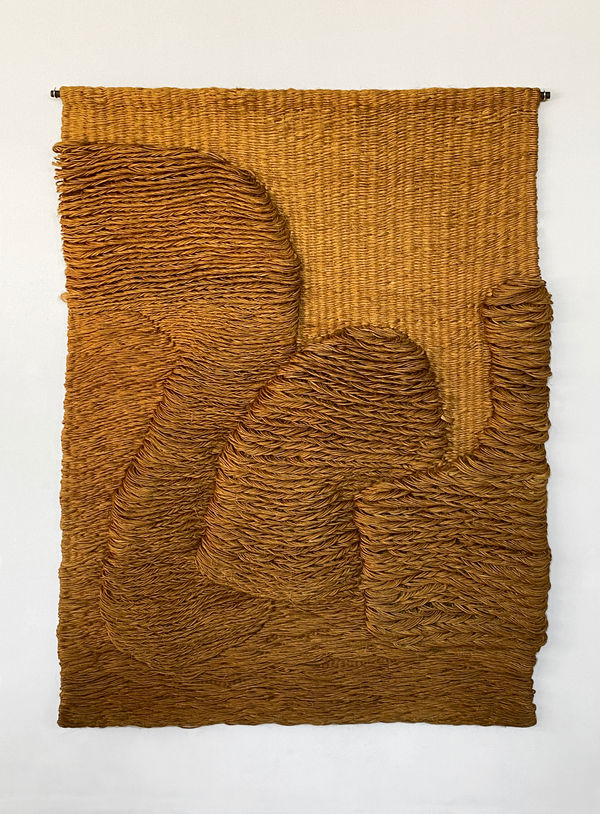
Pieternel Eisinga-Verhoeven Dutch, 1933-2023

Pieternel Eisinga-Verhoeven (1933 – 2023, The Netherlands) was an artist whose practice developed within the rich intersection of textile art, drawing, and monumental abstraction. She studied in the late 1970s at the Department of Fine Arts of the St. Joost Academy in Breda, where she was taught by the Polish artist Jolanta Owidzka.
Owidzka was part of a generation of artists associated with the post-war development of textile art in Poland, where weaving and fiber practices were elevated beyond craft into a powerful, autonomous art form. Within this context, material, structure, and scale became central elements of artistic expression. Eisinga-Verhoeven’s education under Owidzka placed her in direct dialogue with this lineage, and its influence can be felt in her own approach to textile as a spatial and sculptural medium.
During the 1970s and 1980s, Eisinga-Verhoeven developed a body of work consisting of wall hangings and works on paper. Her drawings often functioned as studies and preparatory designs for her textile pieces, revealing a process in which composition, rhythm, and abstraction were carefully constructed before being translated into material form.
Her wall hangings were widely commissioned and acquired, finding their place in municipal buildings throughout Brabant, as well as in architectural contexts, bank branches, and the headquarters of Fokker Nederland. These works demonstrate her ability to integrate art within public and functional spaces, while maintaining a strong visual and conceptual presence.
A recurring theme in Eisinga-Verhoeven’s oeuvre is the interplay between nature and culture—between organic growth and industrial structure. This duality is exemplified in her 1979 wall hanging Laden en lossen (“Loading and Unloading”), in which large industrial excavators are transformed into flowing, almost organic forms.
The work reflects her lived environment at the time: an industrial site in a small Brabant village situated near the Biesbosch nature reserve. Here, heavy machinery and natural landscape coexisted in close proximity, a tension that became a source of visual and conceptual inspiration. In her hands, mechanical forms lose their rigidity and are reimagined as part of a larger, living system.
Across her practice, Eisinga-Verhoeven pursued a refined and deliberate abstraction. Her compositions are often stylized and monumental, balancing clarity with complexity, and structure with fluidity. Rather than depicting reality, she distilled it—seeking to uncover its underlying rhythms and forms.
As she stated:
“What interests me is reducing subjects to their essence on a monumental scale.”
This pursuit aligns her work with broader developments in European textile art of the period, where the medium became a site for experimentation, spatial thinking, and conceptual depth.
Eisinga-Verhoeven’s work has been documented by the RKD – Netherlands Institute for Art History, accompanied by several critical reviews. She was also a member of COSA (Stichting Centraal Orgaan voor het Scheppend Ambacht), an organization dedicated to the development and recognition of applied and textile arts, which later evolved into the Louis Kalff Institute.
Her oeuvre stands as a testament to a period in which textile art claimed its place within contemporary artistic discourse—bridging craft and fine art, intimacy and monumentality, and the natural with the constructed.
-
 Together in the light, 1982€ 7,000.00
 -
Rocks in the Field, 1980€ 8,000.00
-
Shoes, 1980€ 6,000.00
-
Structure, 1981€ 6,000.00
-
Green, 1976€ 9,000.00
-
Flower on the water, 1975€ 8,000.00